
 |
 |

|
 |
 |
 |
||||
|
|

|
|
|
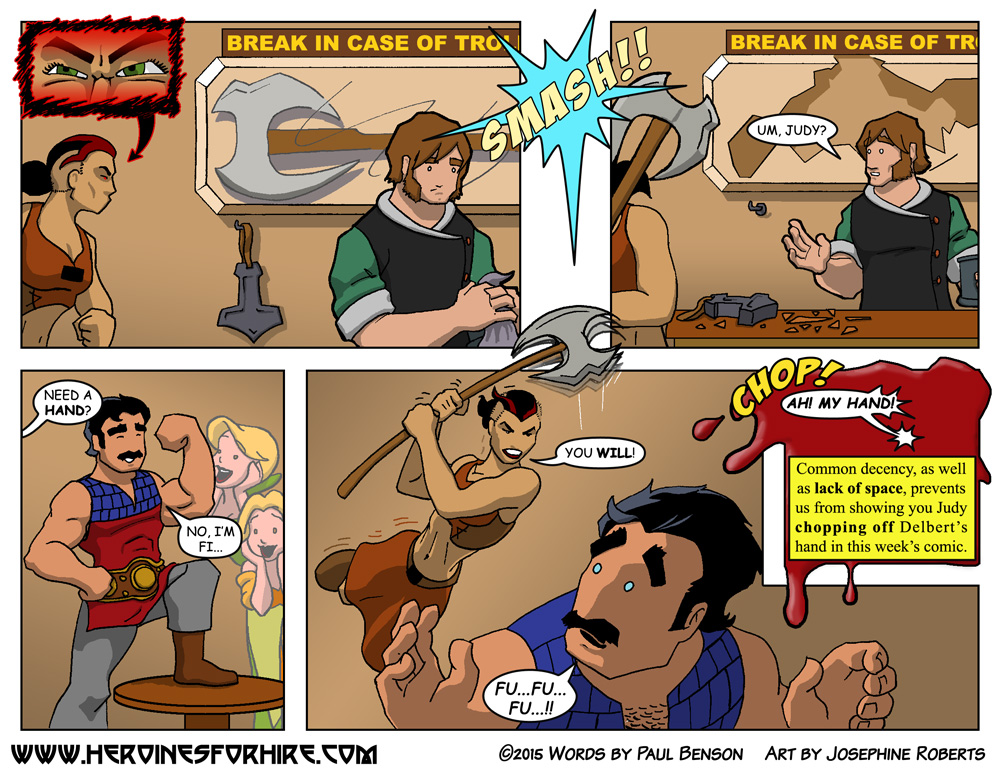
Anger Management, Pt. 3by Paul Benson | Aug 19, 2015 "A key frame in animation and filmmaking is a drawing that defines the starting and ending points of any smooth transition. The drawings are called "frames" because their position in time is measured in frames on a strip of film." That's from the Wikipedia entry for key frames. (we could discuss the reliability or lack thereof with Wikipedia, but that's a conversation for another day). However, it's overall a good description of what a key frame is. Take for example an animation of someone chopping a wooden log in a cartoon. The key frames would be: 1) The axe raised high above the head, and These are the most important frames of the animation, hence "key." At a major studio, a main animator would draw those key frames, while an "intbetweener" or animation assistant would draw the frames between those key frames, providing a continuous flow of action. But wait you say...this is a webcomic, not an animated film! Yes, but when dealing with action in a comic, you don't have a lot of space to get your ideas and story across. So like an animator, comic book writers and artists need to think in terms of key frames. Or in other words, "what's the least amount I can show to get the maximum information across?" In this week's comic, an angry Judy strides over to the bar, smashes the glass case with the axe, and strides away, axe in hand. These actions could have easily played out over many more panels, if we'd wanted: 1. Judy stomps angrily to the bar. That's a lot of panels! If you read graphic novels, you'll see that sometimes the writers and artists will actually show that much action. But you have a little more leeway to do things like that when you're putting out 22 pages or more of comic, every month. If we tried to do something like that, it would take two weeks of comic just to show Judy getting the axe. Instead we do it in two panels, with a sound effect of the glass getting smashed that's between Judy striding up to the bar, and her leaving with axe in hand and broken glass in her wake. I hope you enjoy getting more insight into the process of making this comic. Coupled with Jo's blog from a couple of weeks ago, I think you've gotten a pretty good look into how we make creative decisions. |
||||